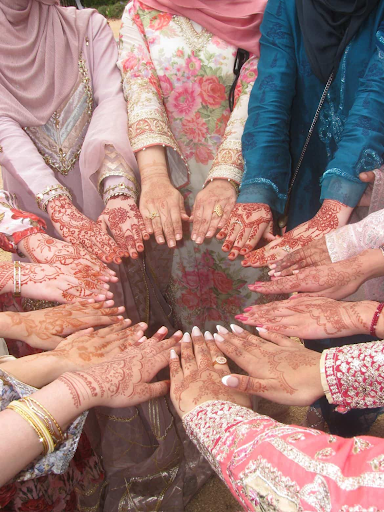
For Udaya Sri Parthiban, mehendi isn’t something she discovered—it’s something she’s always known. Long before it became a business, it was part of her everyday life, shaped by family, culture and repetition.
“I’ve been doing mehendi my entire life,” Parthiban says.
Growing up, she watched her aunt create intricate designs, eventually picking up the skill herself.
“My aunt’s always done it for me, and I always … stole the cone from her,” she says.
What began as imitation slowly became intention. But it wasn’t until the COVID-19 pandemic that her relationship with mehendi deepened. With more time at home, she found herself practicing constantly.
“I got into it a lot during COVID because I really had nothing else to do,” Parthiban says.
That period became a turning point—one where her skills sharpened and her confidence grew. The idea of turning that passion into a business came later, almost unintentionally.
“I didn’t really start my small business until last year,” Parthiban says.
Encouragement from friends played a major role. As she wore her designs to school, people began to notice. “A lot of my friends started noticing,” she says. “They encouraged me to start a small business, just for fun.”
That sense of informality still defines her approach.
“I’m not doing this for profit, I’m doing this for fun,” Parthiban says.
At the same time, Parthiban’s work is driven by something deeper. Part of what motivated her to start offering mehendi was frustration with how it’s often commercialized.
“At theme parks, they would ask for like $17 for a little smiley face,” she says. To her, that felt disconnected from the cultural meaning behind the art form: “I felt like it was a misrepresentation of my culture … very commercialized.”
In response, she chose a different path—offering her work to friends at low cost or for free.
“I wanted people to actually get an authentic experience,” Parthiban says.
That authenticity extends to the materials she uses. “I try to veer far away from chemical stains so you will not get any chemical burns,” she says.
For Parthiban, mehendi is about more than aesthetics; it carries cultural and emotional significance.
“It’s associated with joy, prosperity … especially weddings and good things in your life,” she says. ”It’s really relaxing … it cools your body.”
That experience is something her clients notice as well. Princess Piamah-Assin, one of her friends, describes the feeling of getting mehendi done for the first time.
“It does feel cool to the touch … it’s very cool to see the art,” says Piamah-Assin, only having been exposed to this artwork in elementary school.
Princess initially volunteered as a practice canvas, but quickly saw the potential in Parthiban’s work.
“I’d like to see her expand more … because she’s good at what she does,” she says.
Parthiban’s business has grown almost entirely through word of mouth. One of her first paying clients helped introduce her work to others, and from there, it spread naturally.
“The second she showed her hands… that was instantly like two more people,” Parthiban says.
Since then, many of her clients have stayed loyal. She says that her customers “say that they will never go to any other mehendi artist.”
For students like Inaya Ejaz, that reliability makes a difference.
“I got my henna done last minute, at 10 p.m.. [Parthiban] was willing to do it, and she did an amazing job,” Ejaz says.
While Parthiban works year-round for different events, there are moments when demand increases. Around Eid al-Fitr, for example, her schedule fills quickly as people prepare for the holiday.
“I really just get people during Eid,” she says.
Even then, balancing her work with school can be challenging. “This year was more like we couldn’t find time,” Parthiban says. “Just because of school and all of our extracurricular commitments.”
Despite that, she continues to take clients whenever she can. “Anytime anyone asks me if I’m free, I usually go,” Parthiban says.
Looking ahead, Parthiban’s vision isn’t about scaling her business into something large. Instead, it’s about continuing to share mehendi in a way that feels meaningful and accessible.
“I think it’s something that everyone should definitely try,” she says.
As her work gains recognition on campus, she’s also open to bringing it into larger community spaces.
“Even if I’m not paid … I do a lot of free things,” she says.
Whether it’s for a cultural event, a celebration, or simply a friend asking for a design, Udaya Sri Parthiban’s mehendi business reflects something larger than itself—an effort to preserve tradition, build community and make art feel personal.