What makes an artist and their work unforgettable? For students at Guilford College, the answer isn’t just about fame: it’s about connection.
For Guilford student Aria Nautiyal, the work of Edward Hopper, a 20th-century American realist painter, embodies that kind of connection.
Hopper has created hundreds of pieces, primarily paintings and sketches, yet it’s not necessarily the type of art he creates that appeals to Nautiyal. Rather, it’s the emotions and ideas he conveys through his works that first caught Nautiyal’s attention.
Nautiyal first discovered Hopper in her seventh grade art class, where she said she “recreated the painting ‘Sun in an Empty Room’.”
She was immediately fascinated by his isolationist style, which she has admired and appreciated ever since.
In his works, Hopper uses liminal space in many of his paintings. However, Nautiyal noted that unlike traditional painters who use liminal space, Hopper uses the empty, liminal space to “create the feel that people are within the vicinity, or in the frame, but are not mentally present in their environment.”
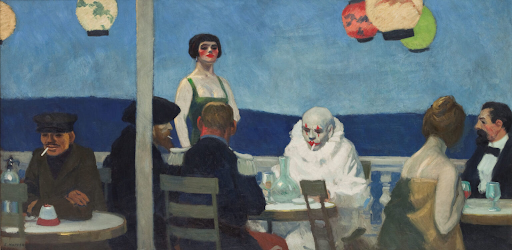
Yet, while his paintings commonly capture the feeling of dissociating from reality, many of the people portrayed in his paintings appear to be deep in thought or talking to themselves. In turn, this creates a feeling of loneliness in the majority of his works, which “probably reflects how he feels about himself,” said Nautiyal.
But for Nautiyal, these paintings never make her feel alone. She feels comforted by the isolation and deep concentration.
The simpleness of his paintings amplifies the isolation and loneliness of his paintings. For Nautiyal, this reaffirms what she believes about people: “that we are often in their own headspace, and when untouched, we can ruminate for hours.”
Nautiyal finds herself especially drawn to “Soir Bleu.”
The painting possesses all the trademark features of any of Hopper’s paintings. However, unlike many of his paintings that depict a single, isolated figure, “Soir Bleu” presents a group setting where everyone is physically together, yet they remain mentally distant.
While Nautiyal finds a personal connection in Edward Hopper’s quiet, external manifestation of loneliness, other students experience the same connection through an internal lens. For Guilford student Sophie Delaney, that connection is found in the raw, exposed world of Frida Kahlo, a 20th-century Mexican painter known for her vivid self-portraits and exploration of identity.
Kahlo is celebrated for her unflinching visual art, but for Delaney, the appeal goes beyond the technical skill of the brushstrokes. It is the radical vulnerability and the exploration of self-identity that define Kahlo’s legacy. Her pieces focus heavily on personal suffering and the complexity of feelings, topics that many artists shy away from, but Kahlo leaned into.
“What speaks to me about Frida Kahlo’s art is the vulnerability and the emotion that she portrays in her pieces,” Delaney said. She explained that the works serve as a mirror, inspiring her to look inward and explore her own identity and self-perception. In a world that often demands a polished exterior, Kahlo’s art offers Delaney a space to be “in touch” with her own emotions.
This theme of internal exploration can be seen in Delaney’s favorite piece, “The Two Fridas.”

https://smarthistory.org/kahlo-the-two-fridas-las-dos-fridas/
This painting captures the duality and complexity of Kahlo’s art. Kahlo expresses this through the painting’s visual tension, in which two figures are physically connected by a single vein; they represent a fractured sense of self. Much like Edward Hopper’s use of liminal space to show people who are not mentally present, Kahlo’s dual self-portrait captures a woman at war with her own identity. For Delaney, this doesn’t just represent Kahlo’s pain; it acts as a catalyst for the viewer to navigate their own thoughts and emotions.