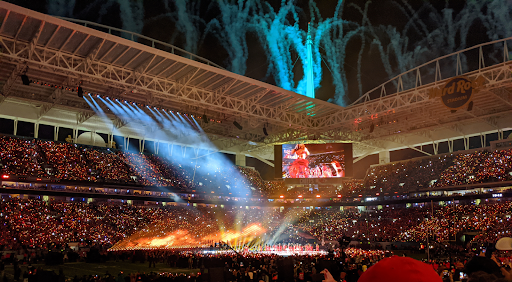
During halftime of the Packers–Cowboys Sunday Night Football game on Sept. 28, fans were met with a huge announcement: global superstar Bad Bunny will headline this season’s Super Bowl halftime show. The reveal sent waves across social media, sparking both celebration and debate among fans and critics alike.
For some, the news came as no surprise. Over the past few years, Bad Bunny has solidified his place as one of the most influential artists in the world. From dominating charts with hits such as “Tití Me Preguntó” and “Monaco” to becoming Spotify’s most-streamed artist for multiple consecutive years, his rise has been nothing short of historic. For others, the NFL’s decision marks a notable shift away from the pop- or R&B-heavy halftime shows of recent years.
The Super Bowl stage has hosted an array of iconic artists—from Rihanna’s powerful return to Kendrick Lamar’s socially charged 2022 performance. Bad Bunny’s addition introduces a distinctly Latin flair that could redefine what the NFL’s entertainment lineup looks like moving forward. His reggaeton- and trap-infused sound stands apart from the typical mainstream formula, highlighting the growing influence of Hispanic and bilingual music in global culture.
Early College student Sophia Delaney was thrilled by the announcement.
“I was celebrating and telling everyone I knew,” she said. “I think it’s really different because it incorporates more of the Hispanic culture and community and contrasts with other artists who have performed.”
Bad Bunny’s selection also raises broader questions about the NFL’s intentions. Some fans view it as a step toward inclusivity; others see it as a strategic move to expand viewership.
“I think the NFL chose him to expand their viewership,” Delaney said. “Maybe to show empowerment for Spanish people, but mainly for the money.”
For Early College student Leon Drew, the announcement carried deep personal meaning.
“I was ecstatic,” Drew said. “It’s a great opportunity to showcase Puerto Rican culture and pride. I’m excited to see what statement he might make—maybe like Kendrick’s show last year.”
Drew noted that Bad Bunny represents “many different styles,” blending pop, reggaeton, salsa, rap and even rock, appealing to a wide audience.
Bad Bunny himself expressed similar pride. In a statement to Reuters, he said, “What I’m feeling goes beyond myself. It’s for those who came before me and ran countless yards so I could come in and score a touchdown. This is for my people, my culture and our history. Ve y dile a tu abuela que seremos el halftime show del Super Bowl.”
Drew also addressed the backlash that has emerged online.
“I’ve seen a lot of hate and racist comments complaining about Benito being this year’s performer,” he said. “But in my opinion, that makes it even better—because they’ll have to face the fact they can’t erase people who don’t speak their language or look like them.”
He added that he hopes Bad Bunny uses the performance to make a statement on Puerto Rican pride, ICE and discrimination against Spanish-speaking communities.
As with every halftime announcement, speculation and criticism are inevitable. Some conservative viewers have objected to past performers who pushed boundaries in fashion, lyrics or political messaging—and Bad Bunny is no stranger to controversy. He has challenged gender norms in his videos and spoken publicly about issues in Puerto Rico, making him both a beloved and polarizing figure.
His selection reflects the NFL’s broader evolution. Since partnering with Roc Nation in 2019, the league has shifted toward halftime shows that emphasize cultural significance as much as entertainment value. By tapping an artist who bridges languages and genres, the NFL appears to be embracing a more global perspective.
Whether this year’s show becomes a celebration of diversity or a spark of controversy, one thing is certain: Bad Bunny’s halftime performance will mark a defining moment for both the NFL and the growing global influence of Latin music.