Originating in Aztec Mexico over 3,000 years ago, Día de Muertos is a culturally rich holiday that now extends far beyond its roots, reaching all the way to Guilford College.
At Guilford, this year’s celebrations were organized by Hispanos Unidos de Guilford (HUG). The club provided students with a unique opportunity to immerse themselves in Hispanic culture by learning more about Día de Muertos traditions.
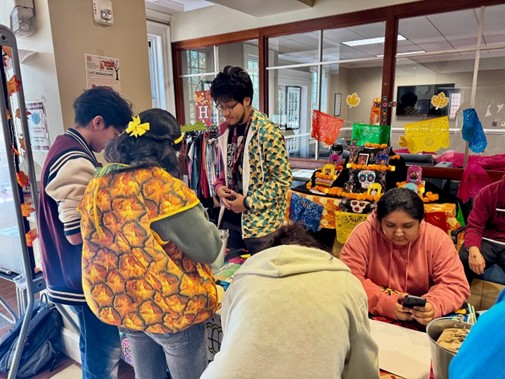
HUG president Erick Trejo Velazquez said the club has celebrated Día de Muertos this year by setting up an ofrenda, or offering, which is meant to honor the spirits of the dead and loved ones who come to visit. Students could bring pictures or memorabilia to leave at the ofrenda, which was set up in Founders Hall for public viewing in the weeks leading up to the holiday.
On Oct. 31—the first day of Día de Muertos—HUG celebrated in Founders Hall, where students were welcome to decorate the ofrenda, enjoy fresh pan dulce and chocolate de abuelita (hot chocolate), and decorate calaveras (sugar skulls).
“I really liked each one of these activities,” said event attendee Zaria Porter. “They allowed me to reflect on happy memories that the loss of a loved one might cloud.”
HUG’s celebration welcomed all students to engage with unique elements of Hispanic culture, while remembering and cherishing those who have passed.
“Día de Muertos represents both a time of mourning and hopefulness,” said Trejo Velazquez. “Mourning because I miss the physical presence of loved ones who have passed on, and hopefulness because for a bit of time they come to visit us.”
A consensus among those who participated in this year’s celebrations was an appreciation for how the holiday approaches death.
“For me, Día de Muertos is a celebration of life rather than a mourning of death,” said HUG Secretary Nataly Aguilar-Hernandez. “We should appreciate those whom we have known and tell stories of their lives to keep their memories alive.”
The holiday’s core messages and values were present throughout HUG’s celebration, despite differences between how it is celebrated culturally in many households and how it was celebrated at Guilford.
“Celebrating at Guilford was a little different from celebrating at home, but it was still nice to be able to celebrate,” said Aguilar-Hernandez. She described how she and her family would normally celebrate by setting up a large ofrenda with different foods and pictures of loved ones, along with a feast where they would share stories about those who had passed.
Aguilar-Hernandez also described how the celebration is done in Mexico. She said that in Mexico, there are much larger festivities split into two days—the first to celebrate the lives of children who have passed, and the second to celebrate the lives of elders. In Mexico, it is also commonplace to lay out marigold flowers in streets and homes to help spirits find their way home.
While the Día de Muertos celebrations at Guilford may vary from those in most Mexican and Mexican-American communities, they are critical for sharing Hispanic culture and traditions with all students.
“Even though I don’t celebrate the holiday in my household, I think celebrating it at school is a really beautiful thing,” Porter said.
Including all students, regardless of their cultural background, is a major goal for HUG in its Día de Muertos celebrations and its other activities and events throughout the year.
“It’s important for clubs to represent themselves, as it reminds us all that we come from different places—and that is something worth celebrating, not denouncing,” Trejo Velazquez said.
“Día de Muertos is just one of those examples, and it allows people to see outside of their bubbles or spheres.”
Día de Muertos represents more than a celebration of life and death—it is a celebration of community and the values that tie us together.